From the Trainer's Desk
Articles by Palani Murugappan
Palani writes about data, decision-making and leadership through the lens of something he knows just as well: the trail. A few of his LinkedIn articles are collected below.
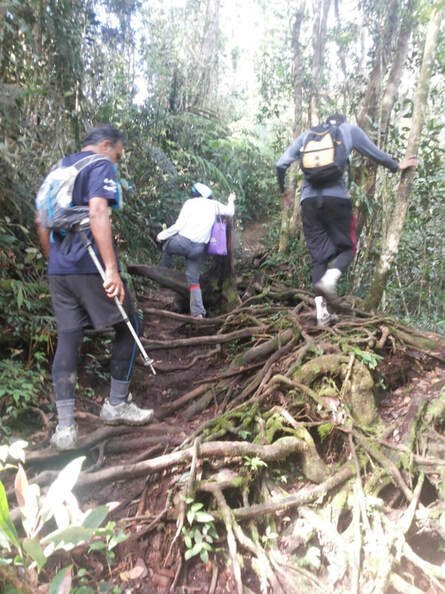
How does that relate to you? We move through daily routines assuming we already know how they'll turn out. Now imagine being genuinely lost in the jungle: your phone is suddenly not so smart, and you have to rely entirely on memory. Did you actually notice the signage on the trees, the boulders you stepped over, the fallen branches you trampled to move forward?
Working with large amounts of data is remarkably similar to hiking through that jungle. A seasoned outdoor enthusiast paces themselves by distance, elevation and difficulty. A beginner finds the same trail a lot more daunting. It's identical with raw data: someone experienced spots the patterns and trends fast enough to make quick decisions, while a beginner sees only a jumble of alphanumeric characters.
Then comes the next level of challenge. The enthusiast tries comparing past results with current ones, only to find the outcome doesn't match expectations. That's the data equivalent of looping back to where you started in the jungle — you missed a turn. With data, it usually means something was recorded incorrectly, or the format itself was wrong. The source data was never properly captured for the analysis, and the decision built on top of it ends up wrong too. That is the real danger of uncleaned raw data.
An avid hiker, author of 51 books, and a data analysis and analytics trainer for more than two decades, Palani relates the process of working with raw data — cleaning it, structuring it into usable form, analysing it, and finally presenting it through clear charts and infographics — back to lessons learned on the trail. Email him at avimurinfo@protonmail.com for a quick walkthrough of how your own data could work in your favour.
I watched our seven-year-old trying to read our wall clock. I put myself in her shoes — it really is a skill to tell the time precisely at a single glance. My wife spent about thirty minutes explaining how it works. To our surprise, she caught on fast. Was it the child's natural intelligence, or the way the knowledge was delivered? A bit of both, I think.
The ability to grasp something new becomes far more achievable once the subject is made genuinely interesting — through clarity, benefit, and a spark of passion to learn. That's how I judged what happened with our daughter. The night before, I'd asked whether she'd been taught to read time at school. She could read digital numbers, but not Roman or Arabic numerals on an analogue face. Would she like a nice pink analogue watch? The answer was obvious. Without her realising it, I'd already prepped her mind on why time matters and how it could help her organise her day, before she dozed off.
Picking up a new skill isn't difficult. A seven-year-old proved that, once the right incentive was dangled. As a trainer in data management for the last twenty years, one of my constant challenges has been how to impart knowledge with genuinely high retention. "Show me, don't tell me" worked well at first. But as the entry-level knowledge required climbed higher, I needed other tools — so I turned to data storytelling.
Sharing an experience always lands, and I do this constantly through my hiking trips (and the occasional misadventure). Participants today want to feel your own experience and relate to it — that's the whole art of storytelling. A story told well touches something core in a person. It lengthens attention span as the imagination gets to work, boosts creativity and focus, and improves listening without anyone realising it's happening. The trick is still linking the story back to your main topic: once your audience is glued to your voice, that emotional connection dramatically increases how much they retain. You've got them — so recall your experiences, and bring them alive.
Read the full article on LinkedIn →
In more than twenty years of hiking and trekking — steep trails, wild animals, spider bites, leeches, bee stings, and plenty of fellow hikers along the way — some of my most memorable moments came from what followed a fall during an off-trail stretch. Memories like that linger, good or bad, and remind us that we keep walking the path we've chosen, regardless.
As a regular weekend hiker at Bukit Gasing, I've always shared these experiences with training participants and invited them to join me. A few have, and are now good friends. I see real discipline, consistency and persistence in the ones trying to conquer the summits I take them through — some are even off medication, and a few more are on a lower dosage, simply from becoming regular hikers.
In early 2019, our hiking group planned to conquer Mount Fuji on Merdeka Day — something to remember for a lifetime. We trained regularly, and for the newer hikers, we made sure they understood exactly what to carry for high-altitude climbs.
In early August, at what felt like peak fitness, the call came mid-hike. I usually don't answer calls on the trail — most times my phone stays at home. That day, for some reason, I picked up. It was someone from a smaller, newer group who was running late and unsure of the trail, waiting at the entrance. I turned around fast, not wanting to keep either group waiting, and didn't notice my right shoelace had caught on a nearby tree root. I lunged forward and fell hard, still holding my phone in my right hand. To break the fall, I used my left arm instead of hitting the ground directly, and heard a pop from my upper left arm. For a few moments I was blank, sure my shoulder had dislocated. Getting up, I felt a sharp pain swinging that arm — a little better once I kept moving. I wiped the blood from my left elbow and headed back to the entrance, brought both groups together, and carried on the regular trail, barely registering the pain except when I swung my arm quickly.
Pain rarely announces itself right away, unless you already know the extent of the damage — that's largely psychological, I think. At home, I cleaned the heart-shaped tear on my elbow and treated it. As the days passed, it clearly wasn't healing well. My wife reached out to a fellow hiker who happens to be a doctor, and her care sorted it out properly.
What had I actually gone through? In management terms, this is disaster recovery. In training, it's the moment a participant asks a question and you simply don't have the answer. Does that put you in a bad spot? Not really. Stay calm, think aloud, and consider opening the question to the room — as a subject-matter expert, the answer is usually reachable once the brain gets moving.
While trekking, I've often hit a split in the trail and had to decide quickly which route to take. I've always trusted my gut, and it's proven right more often than not. Losing yourself to nature is better than losing yourself in it. One of the safer moves when lost is to backtrack and look for a well laid-out clearing — it usually leads back to civilisation.
Disaster recovery, in any field, runs through four phases: mitigation (taking the right steps to prevent an emergency), preparedness (getting ready ahead of time), response (the immediate aftermath), and recovery (rebuilding afterward). At a deadlock on the trail, which direction do you take? Mental preparation matters — it's natural for the brain to trigger panic. Your response is your survival in that moment. Think back to what you've already passed — the trees, rocks, streams, bridges — and let your recovery be guided by that memory. Before long, you're back on track.
Two years ago, my hiking group planned to climb Mount Kinabalu with several first-time climbers — my fourth time up. We trained hard, building not just physical strength but mental endurance. Our older son, fifteen at the time, wanted to climb with us. Alongside our regular weekend training, we tackled other mountains in the Peninsula to prepare, including Gunung Ledang's notoriously steep, ladder-heavy "KFC" trail. The teenage boys, our son included, were among the first to reach that peak — my confidence in him grew.
Then came Kinabalu — a different kind of challenge. Some call it a "tourist mountain" with well-laid trails, easy enough for most. Being a typical teenager, our son chose to climb with his friends instead of his father. Fair enough. But as we climbed higher, I could see the thin air starting to affect him, and still he pushed on with his friends. I trusted he was in safe hands and let it be — until he was nowhere in sight. We waited a good thirty minutes for him at Laban Rata (3,270 metres), where we spent the night.
Around midnight, we prepared for the final ascent, with the gates opening near 2am if weather allowed. It was clear that morning, so we set off. Again, he chose to climb with his friends, and in the crowd and darkness, I lost sight of him. I kept turning back, unable to tell if he was nearby. At the Sayat-Sayat checkpoint (roughly 3,700 metres), the wait felt endless. I wanted badly to push on to the peak but held back. Almost everyone in our group passed through — except him. My heart pounded faster, and I began to shiver, and not from the cold. The checkpoint closes sharp at 5am, turning back anyone who hasn't arrived before sunrise. I asked every guide coming through about him. The first two said he was climbing slowly. The third made my heart jump: our son was throwing up, altitude sickness hitting him hard, unable to continue. I wanted to rush down immediately but wasn't allowed to go alone until sunrise. Much later, I found him asleep on his bunk.
At that checkpoint, I met four distinct personalities. The first were self-centred — focused purely on their own summit, a quick hi-bye as we passed. Then came the role-models, genuinely concerned, with clear leadership and confidence — one stayed with me so all three of us could summit together, and I loved him for it. Next were the reserved ones, mostly guides, showing no expression yet clearly emotionally steady at that altitude, simply doing their job. Last was the average personality — the one I fell into. At that height I was anxious, guilt creeping in, neurotic even. Plenty of people said the expected things — carry on, wait a little longer, he'll be fine — but not one suggested going to look for him. I think they knew the trail was safe and he had a guide. My goal was only ever to summit with him, not without him.
So when should you quit? A few pointers helped me think it through: knowing your resistance level (the Why — why is it there), the voice of your resistance (the What — what's causing it), changing the pattern of your resistance (the Would — would it create real impact), and testing your resistance differently (the Whether — whether to proceed at all).
At the checkpoint, I worked through every one of those. The hardest was the Would. Family back home was waiting to hear that we'd summited together, and the disappointment was real. But there's always another time. Altitude sickness can hit anyone, regardless of fitness — the body needs time to acclimatise, and that can't be rushed for everyone. My Would resolved itself once I had an honest answer to the What.
It's a situation many of us go through, in different forms, without ever naming the W's behind it. The drive for consistency and the desire to succeed often take over — but sometimes, a compromise is exactly what's needed. Think about your own decisions: have you worked through any of these four W's?
Read the full article on LinkedIn →